We want council rent housing, not council-led social cleansing
New report commissioned by Public Interest Law Centre and authored by Dr Joe Penny of UCL’s Urban Laboratory shows how government and council defined ‘Affordable housing’ drives up the cost of homes for working-class communities.
The report finds that estate regeneration projects which feature demolition routinely underproduce truly affordable* housing for those on low incomes, and increase rents of council and social housing by an average of more than £80 per week. It reveals that the unaffordability of “affordable” housing options, replacing council-rent homes after estate demolition, is worsening the housing crisis for working-class Londoners. At the same time, councils are playing ‘property developer’ driving forward gentrification. Therefore the call for ‘council housing, not council cleansing’ is arguably more fitting today than ‘social housing, not social cleansing’.
*Truly affordable housing is the term benchmarked in the report using the UN-Habitat’s definition of affordability: rent that costs no more than 30% of a household’s total monthly income. The report found that for some tenures on redeveloped sites, so-called “affordable” rent could be as high as 76% of a household’s income.
Main findings of the report
The report studies six of the ‘best’ and ‘worst’ regeneration projects across three London Boroughs including the Aylesbury Estate and the Heygate Estate.
It considered three different models of cross-subsidy estate regeneration: developer-led approach, local-housing company approach, and council-led approach.
Across all three cross-subsidy models in the report:
The loss of social and council housing and the displacement of low-income working-class tenants are embedded features of regeneration projects that involve demolition
All underproduce the housing that Londoners need the most (council rent and social rent)
All overproduce the type of housing London has the least need for (market sale and rent)
The total number of council and social housing was reduced by all but one of the regeneration projects
Demolition and redevelopment of council estates increases the rents of council and social housing by more than £80 per week on average
23,551 new homes have been or are expected to be delivered by 2035
8,629 council rented homes have been or will be demolished across the six cases
There will be a net loss of 2,151 truly affordable council homes
Of the homes due to be built, just 6,478 (27%) of these homes are replacement social rented homes
Almost double the amount of social or council homes will be for private market sale or rent (11,961, 51%).
Cross-subsidy models don’t produce affordable housing
The cross-subsidy approach to estate regeneration has been the dominant model of estate regeneration for the past two decades and looks set to continue under the Labour government.
This is when council estates are demolished to make way for expensive properties which are put on the market or rented privately. In theory, the new private homes fund the construction of “affordable” homes on the sites.
However, the report has found that the word “affordable” is used with no consideration for what is truly affordable for people who need these housing options the most. It is being used to platform affordable housing solutions for middle-income earners being prioritised over housing solutions for the record levels of people in temporary accommodation – 145,800 children in temporary accommodation – up 15% in a year.
Just open the door!
At the report launch, a member of Focus E15 housing campaign and resident from the Carpenters Estate in Newham, East London, gave a fitting analogy for the housing crisis from the position of a temporary tenant living on an estate facing cross-subsidy redevelopment: “it’s like you’re watching a film and there’s a car on the train tracks with someone inside struggling to get out as a train speeds towards them…they are trying everything but the door handle…and you are screaming at the screen for them tojust open the door! We need to open the door!”
On Saturday 19th October Focus E15 campaign will be holding a speak out demanding an end to temporary accommodation, and calling for safe secure truly affordable council housing! Join us!
12pm-2pm / outside former Wilkos on the Stratford Broadway, Newham E15.
This is an URGENT message for anyone interested in human rights, women’s rights, children’s rights and the ruthless cruelty of a Labour council.
Newham Council has discharged its homelessness duty to a pregnant woman who has a toddler and is due to deliver her second baby in February (therefore anytime now). She is currently living in Brimstone House, where families languish in emergency and temporary overcrowded accommodation in rooms built for one.
This piece is being published on Monday 10 January, the day that Newham Council’s responsibility for providing further temporary accommodation to this family ends.
The council housing officers have emailed to clarify and confirm there is no intention to evict this family on 10 January, but make it clear that this could happen if the council applies to the courts for possession. The council officer casually adds in the email that there will be more than sufficient notice if this happens.
HOW CAN THIS BE?
At the end of September 2021, this family was offered a move from Brimstone House, Victoria Street, E15, to another temporary accommodation. It was not a great place for various reasons including an insecure door that was a worry about safety, and she felt it not appropriate for her and her 21-month-old child and baby to come. She refused the offer and immediately Newham Council discharged its housing duty to the family. Within a few days, knowing the consequences, frightened about eviction and homelessness, struggling with her mental and physical health, she changed her mind and contacted the council. But too late for Newham Council, who don’t recognise a change of mind, and clearly would rather see families homeless than reverse their callous decisions.
A review was undertaken by another housing officer who concluded that they are satisfied that she refused a reasonable offer and will be able to manage in the private-rented sector and that there are no exceptional circumstances and the council will not be exercising any discretion. Therefore the reviewing officer upholds the decision that the council has no duty to secure this family with accommodation.
This is disgraceful. But it is also terrifying, because to say that someone can manage in the private-rented sector is to assume that they have money for a deposit and several months’ rent and a rich guarantor.
WHAT NEXT?
If Newham Labour Council insists the discharge of housing duty stands, they will proceed to evict this family and she will go into labour homeless and once she has delivered her baby, she must make another homeless application and has to be provided with emergency housing. Or perhaps the council expects her to make an application to court and challenge this situation in the last few days or weeks of her pregnancy. Neither are a satisfactory way to treat a family in need.
Court-mandated evictions have increased by 207% after the pandemic-related ban was lifted. In England there are 95,450 homeless households, two thirds of them with children, living in cramped and unsuitable temporary accommodation.
Focus E15 campaign stands with all those struggling for decent housing. We challenge Newham Labour Council to do the right thing and start 2022 by showing this family some compassion and humanity.
No such thing as intentional homelessness! No discharge of housing duty! No eviction!
Join us at the Focus E15 street stall on Saturday 15 January at 12pm outside Wilkos to make a stand for housing justice for all!
RESIDENTS ACCUSE NEWHAM LABOUR COUNCIL OF SPENDING PUBLIC MONEY TO FORCE THROUGH A VOTE FOR DEMOLITION
On Tuesday 14 December 2021, a resident ballot on the Carpenters Estate in Newham, East London, returned a Yes vote in favour of the council’s regeneration plans, meaning almost 60% of the estate will be demolished for ‘regeneration’. This is a deep blow for residents who want to refurbish and save the existing estate as it is.
Residents have called out the whole of the ballot process as being deeply biased in favour of the council’s plans. Newham council and the council’s housing company, Populo Living have spent at least £350,000 on campaigning for a Yes vote, whilst campaigners had no access to public funds.
Throughout the consultation and ballot process, Carpenters’ residents and supporters of Focus E15 campaign have complained of underhand tactics used by Newham Council and Populo Living. Blatant propaganda posed the council’s plans as the only viable option.
For example, Populo Living’s newsletter of October 2021, states:
The future of The Carpenters is up to you – if you want to build a stronger estate, you need to vote YES in the ballot at the end of October.
‘Vote Yes’ graphics have been seen on billboards, newsletters, community spaces and in the Landlord Offer document which the vote was based on. Residents have told of continual door-knocking on the estate by both Populo Living and Source Partnership employees who are the Independent Resident and Tenants Advisors.
A huge amount of public money has been spent in the process of canvassing for a yes vote. A Freedom of Information request found out that at least:
£146,275 has been spent by Newham Council on running consultancy services
£224,000 has been sent by Populo Living on running consultancy services
£4,400 was spent on a Community fun day
Newham Council has followed the GLA’s Good Guide to Estate Regeneration in order to secure funding for future development.
However from July 2018 to March 2020, all of the ballots held on estates in London have resulted in ‘Yes’ votes for regeneration – in every case this resulted in demolition.
Councillors in Haringey have been so outraged by this process that they have called for an independent inquiry into the regeneration ballot carried out on the Love Lane Estate, following allegations of pressure put on residents.
Under GLA guidance, neither Newham Council nor Populo Living is required to put forward a balanced argument and they are allowed to lobby with huge resources for their preferred position. Residents who wish to lobby against the council have no resources made available to them.
Such one-sided campaigning and clear inequality are unlawful in referendums and elections.
The Greater London Authority and Local Authorities’ ballots are a cover, using the voting and the notion of democracy for ultimately destroying council homes. This corrupt and unequal process must end.
Focus E15 campaign and residents will be meeting on the Carpenters Estate, Newham, London E15, from 12-2pm on Saturday 18 December (next to the shop in the middle of the estate) to discuss the next steps in our campaigning, to shine a spotlight on housing issues in East London and say to the council and Populo Living:
Hands off the Carpenters Estate!Join us and residents to make more planson Saturday 18 on the estate. Together we are stronger.
A local resident speaks to Focus E15 campaign about what Carpenters Estate means to her.
When I reminisce about my best moments growing up, I always think of the Carpenters estate. I can’t imagine growing up in a more fulfilling community.
Across all generations we supported one another. You had the over 65s, some who had known each other since the 2nd World War. They had grown up together and then raised their children together. It was a very close, caring and supportive community that felt more like a family. Us children would all attend Carpenters primary school and play together afterwards in the lovely green spaces and park. There was so many different cultures too, I tried so many different cuisines and learned a lot by being around different ethnicities and religions. I actually believed the whole world was multicultural like the estate I grew up on, because to me Carpenters was the only world I knew.
Over the years we have seen people be moved away and relocated. It started with the Olympics. So many people were paid off and moved on. The place was becoming more and more deserted and neglected. There was never a problem to start with on Carpenters, it was just an inconvenience to Newham council and the London Olympics to have ‘common people’ so close to the games and the new Westfield. They were creating a new Stratford and we were an inconvenience to that image.
Now they are proposing to regenerate the whole area! That will mean 60% of homes being demolished. That includes my Grandmothers house which she worked her whole life to own, just to be told in her early 80s that she is at risk of losing it, because they need the land now for their new plans. It’s all what works for them and they never consider the people they are affecting. My Grandmother had been very stressed due to thinking she had to move. Carpenters estate is all she knows and she loves her home and didn’t want to move. Also she was worried about decorating or changing carpets in case she is forced to move.
The council have said that the residents of the estate supports demolition which is a lie. Why would we want our homes destroyed? If they want to support residents, why not improve the conditions on this estate right now? We had already voted for refurbishment over redevelopment but now they are saying something completely different. They have been trying to degrade the estate to make it seem that they have the solution, which is to demolish, because in the long run, it’s what’s makes them the most profit, they do not care about the welfare and health of the elderly and the stress and affects on mental health of local residents.
We must Vote No to keep Carpenters alive and rebuild a community that they demolished years ago. Choose refurbishment over demolition. Community over Capitalism. Everyone deserves a place to live and to stay in their homes that they love and feel content in.
What can you do to help?
Join the Focus E15 campaign street stall outside Wilkos in Stratford from 12pm and then on the Carpenters Estate near the shop this Saturday 20 November from 1pm.
Thank you to Piero Corcillo for this guest blog post based on his research on the housing developments that were built on land cleared for the hosting of the Olympic games in 2012. Piero kindly spoke about this research to a public meeting to Focus E15 campaigners at the end of last year. The knowledge that we gained from the facts in his talk has further empowered us and shows that the fight for the Carpenters Estate to be even more urgent.
Social Mixing and the London East Village: Exclusion, Habitus and Belonging in a Post-Olympics Neighbourhood
Piero Corcillo
This research is based on fieldwork conducted in the London 2012 Athletes’ Village – now East Village – in Stratford (a Newham Borough’s district located in East London). The thesis argues that various processes, practices and actors come together to produce an environment that prioritises and valorises the perceptions and preferences of white middle-class individuals. East Village, which was presented as a key element of the Olympic Legacy objective “Homes for All”, is a space that actively reproduces the exclusion of working-class and BAME individuals who make up the majority of Stratford and Newham population. Therefore, the intentions of social mixing are not met in practice.
The Landlords
In 2009, Triathlon Homes (TH) – a consortium between East Thames, Southern housing Group housing associations, and developer First Base – purchased 1,379 flats that were set to be affordable and social housing. In 2011, Qatari Royal family’s sovereign fund Qatari Diar, and British developer Delancey (QDD) purchased the remaining 1,439 properties, together with the public and retail space, as well as the freehold. QDD have set up Get Living London (GLL) as their housing management arm to let their luxury apartments on the Private Rented Sector.
TH is a private provider. Nevertheless, it was able to obtain a £110 million public grant from the UK government’s Home and Community Agency (HCA), and purchase socially rented apartments at the East Village. 675 of TH’s properties are available for social rent, while the remaining 704 are a mix of so-called affordable housing: shared ownership and intermediate market rent. Shelter charity and authors such as Paul Watt and Penny Bernstock have raised concerns about the effective affordability of these properties, which are not affordable for East London low to middle-income households. Concerns have emerged even with respect to social rent. In fact, TH’s social housing allocation policy is to prioritise in-work applicants and disabled people. TH also reserves the right to reject an application for affordability reasons, if a prospective tenant has got insufficient financial means to afford the rent and service charge. Triathlon also reserves the right to terminate a tenancy for antisocial behaviour. A private entity such as TH acts like a judge that questions prospective tenants about their financial capacity, entitlements and attitudes to demonstrate their fit in the neighbourhood. The result is that the most marginal applicants are rejected.
When a new social tenancy starts, the combination between rent and service charge is capped at the maximum social rent level allowable by the HCA. However, after the first year, rent and service charge increase annually, such that social rent levels become higher than what is prescribed by the HCA for registered landlords in receipt of public grants. Being privately owned, TH’s social housing units become subject to market logics, and they are no longer a form of welfare support for those who experience housing need.
Tenure Mix, Security and Design
Despite policy-makers claims, there is a sense that a real mix of tenures within East Village was not a genuine part of the plan, given that QDD and TH blocks are separated. Moreover, socially rented flats tend to be concentrated in different blocks. Even in the buildings where there is a mix of shared ownership, intermediate rent and social housing, the various tenures are often located in different floors, and socially rented flats tend to be concentrated on the lower levels. One is therefore left with the impression that the aim was to set the tenure distribution in a way that kept the most affluent residents separated from the least affluent ones. Such a separation has not facilitated social interaction between neighbours with different socio-economic backgrounds. On the contrary, it has fostered the identification of “us”, the hardworking and well behaving home owners, and “them”, the lazy and unruly social renters; with housing tenure becoming a synonymous of class and ethnic divisions. While Triathlon claims that it would be “near impossible” to know which flat is for social housing and which one is not, the residents know very well where social housing is. “The people who live downstairs” to point to social renters’ “antisocial behaviour” was a recurrent expression in the interviews with shared owners.
East Village’s design has been elaborated in collaboration with Secured by Design, a police initiative that specialises in security features and crime prevention projects. The various plots are equipped with secured entry doors and gates.
East Village’s Secured Doors and Gates
(Source: Piero Corcillo)
Moreover, the landlords have set up the East Village Management Company (EVML), which operates 24/7 CCTV, and employs security guards to patrol the public ground. Building gated communities serves the need to capture and defend social space, especially when white middle-class enclaves like East Village are built near lower-end areas. This vicinity fosters fear of crime and Mixophobia, which, according to Bauman means anxiety and discomfort about diversity.
EVML employs private security to protect residents from real and perceived external threats. However, the security also “protects” them from each other. The East Villagers are encouraged to refer to EVML if there is an issue with some neighbours. This could be viewed as an interference with the private sphere of interpersonal relationships. However, affluent residents approve this policy and they are happy to minimise contact with the neighbours, especially with social renters.
Residential Space and Lifestyle
The spatial dimension of Pierre Bourdieu’s field theory suggests that the Habitus of white middle-class individuals influences their residential trajectory. As Michaels Benson has attested, they look for neighbourhoods congruent with their lifestyle, preferences and perceptions. QDD’s branding strategy is to stimulate affluent home seekers’ pre-existing dispositions. Words and photos representing local parks, gardens, waterscapes and local shops are very frequent in their advertising material. The area is branded as a green island that offers a healthy retreat from the chaos of London.
The Village’s environment requires high levels of maintenance. QDD understands the importance of living near nature and in an aesthetically pleasing environment for the white middle classes. They reproduce glimpses of wildlife, and EVML employs gardeners and streetcleaners to work on a daily basis to maintain the East Village public realm on a high standard of aesthetically pleasing, tidy and clean space. Contact with nature becomes a product for visual consumption. Residents interiorise the landlord’s branding strategy. The idea of East Village as a holiday place, a retreat from the stress of urban life is a recurrent theme in the interviews.
East Village Greenery
(Source: Piero Corcillo)
Moreover, with an awareness of the importance that local sport classes and events, such as markets and outdoor cinemas, have for affluent individuals, QDD organises these activities as part of the complete East Village package that they offer. Residents are not permitted to organise events independently. Everything that happens in the neighbourhood’s public realm must be planned and supervised by QDD. When events take place, seldom they foster active participation or interactions between neighbours. Yet, they convey a sense of belonging and localness.
East Village Events
(Source: Piero Corcillo)
However, the processes described above, happen in contrast to an outside world – the Stratford area and its residents. The residents’ narratives of belonging draw clear socio-spatial boundaries between the cleanliness, vibrancy and beautiful landscapes of East Village, and the dirt, disorder and ugliness of the wider Stratford area. A sense of Mixophobia emerges in relation to the “other” that lives in Stratford. Residents highlight that East Village has a totally different atmosphere from the rest of East London. These feelings demonstrate the fallacy of the promise to deliver an Olympic Legacy “for the direct benefit of everyone who lives there” as the London 2012 bidding team claimed. Even the presence of Stratford children in the Chobham Academy – the East Village public primary and secondary school – generates animosity. They are held responsible for the problems that the East Village children experience at school.
The Retail Infrastructure
For middle-class individuals, artisanal products and locally-produced goods have a high cultural value. The East Villagers describe the shops in the neighbourhood as independent, in the sense that there are no chains. They are tailor-made for young, white middle-class residents. The shops are mostly food-based and they are there to complete the environment that the greenery and aesthetics of community have created, and that is intentionally cultivated by GLL on behalf of QDD. In reality, these shops are not independent. They are purposely selected to comply with QDD’s aspirations for the area.
The retail infrastructure becomes a symbol of the middle-class character of the place. The shop keepers act as social and cultural entrepreneurs. When I spent time in one of the Village’s cafés, I saw the managers and staff systematically building relationships with customers. They offer free bread to new customers, so that they come back, they talk to them, and babysit their children. This goes beyond the average staff-customer relationship. However, this is another product for the consumption of an idea of community that QDD offers.
The working-class and BAME residents who do not possess sufficient amounts of economic and cultural capital to afford and frequent the East Village shops are alienated from their middle classed and westernised eateries and atmosphere. QDD pushes back ethnically diverse and low-cost shops, by requiring unaffordable financial conditions to those who would like to open them. They are deemed to threaten public order and the place’s respectability. The affluent East Villagers develop a sense of moral ownership over the neighbourhood’s retail infrastructure. The healthy food restaurants and trendy shops belong “here”, in the Village; downscale shops and unhealthy restaurants as well as their BAME and working-class customers – belong “over there” in the Stratford area.
Despite being unable to afford the prices, several social renters agree with the landlord and their affluent neighbours. They become unconsciously complicit with the unequal power relations, norms and values that become hegemonic in the area, and perceive them as fair and just; a process that Pierre Bourdieu describes as symbolic violence. They claim that East Village is meant to be an upper-class area of Stratford, where they feel privileged to live. Again, this goes to the heart of the Olympic promise. The residents experience the neighbourhood as something very different from what was supposed to be: a 50-50 affordable-private, socially mixed development. Particularly damning is the fact that QDD and TH allowed the East Village’s community café – arguably the only place designed to be truly inclusive of all socio-ethnic groups in the space – to be shut down due to lack of funds to keep it running.
Policy implications
Despite the presence of many master-planned communities in London, seldom can we observe this level of micromanagement. QDD captures part of the sovereignty that public authorities exercise over urban space, and uses its authority to tell residents how to behave, as well as deciding who belongs and who does not. A state that aims at delivering socially mixed neighbourhoods and affordable housing through mega-events and partnerships with large housing corporations legitimises instead the logics of social inequalities.
Michael Romyn, London’s Aylesbury Estate: An Oral History of the Concrete Jungle (Palgrave Macmillan, 2020) The estate was like a shiny new penny. It was lovely. It was really lovely. It’s hard for me to paint a picture for you but it was a beautiful place to live … The community side of it, you […]
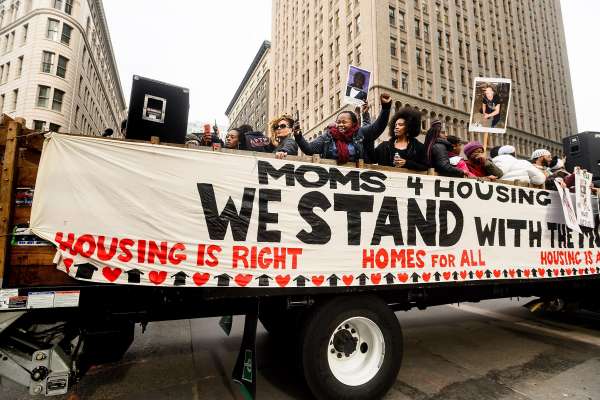
On Sunday 19 April 2020 Focus E15 campaign in Britain and Moms4Housing in the USA organised an online webinar to discuss tactics during the Covid19 pandemic. Focus E15 campaign have edited the audio and are releasing it as a podcast which you can find below. During the meeting attention was turned towards ways to take action on May 1st to mark international workers day and to take our campaigns for decent long term secure housing onto the streets.
On Sunday 19th April at 6pm London / 10am California join us for this meeting co-hosted by Focus E15 Campaign in London, England and Moms 4 Housing in Oakland, California, USA https://moms4housing.org/
There are four times as many empty homes in Oakland as there are people without homes, and in the UK there are double the amount of empty homes as homeless people.
The Covid-19 crisis has escalated the need for action to allow everyone to be housed and live in dignity and safety.
This session will hear from grassroots organisations either side of the Atlantic who are taking action against this same problem. We are using this time of crisis to share experience, education and ideas for action.
‘If anything happens to me, it’s on Newham (council). I’ve told you my situation!’
A mother of two young children with a third on the way, shook the walls of Stratford Town Hall last Monday evening as she addressed the full Cabinet meeting of Newham Council and outlined her increasingly dangerous and unmanageable housing situation. She is due to give birth in little over a month.
Newham council left this expectant mother and her children stranded and isolated when they forced the family to move from temporary accommodation in Newham in Brimstone House to Southend on Sea by threatening her with ‘intentional homelessness’ if she did not accept an offer of accommodation out of London. She states:
‘’I cannot describe this as a choice, as a mother cannot choose to make their children ‘intentionally homeless’. So I was forced to accept this offer and have been in Southend-on-Sea since July 2018.”
She further explains that:
“The flat I am in is on the second floor and the building has no lift. I have to climb 30 stairs with my two young children, as well as my shopping and with my double buggy, in an advanced stage of pregnancy. I regularly injure myself because of this, and I fear that something worse could happen. I feel scared to leave my children in my flat (when I leave to go get my shopping & buggy from downstairs) as they are very young. This will become even more difficult after the birth of my 3rd child.
I have absolutely no support networks in Southend-on-Sea, and when I go into labour I worry that I have nobody who can stay at home with my young children. All my support networks are in Newham where I lived for 6 years.’’
After trying to contact Newham Council and getting little response, she reached out to Focus E15 Campaign as an ex-resident of Brimstone House and joined forces with current Brimstone House residents who have just submitted a legal complaint to Newham Council about the awful living conditions in the hostel.
However, a worrying development is that following her speech at the cabinet meeting, she was contacted by a housing officer in Newham the next day, and told that ‘she would have to be moved even further than Southend to find affordable housing’. This is threatening and abhorrent.
We call on the Mayor and the Council to immediately move this mother and her children back to Newham. She is asking for her right to be housed in her community for the long term benefit of her children. A pregnant mother should not be left to give birth alone or be cast out. She needs to be back in her community so that she can get the support she needs at this vulnerable time in her life just before she goes into labour. The issues of class, race and gender are present in this case and Newham have left her in a very precarious situation far away from all those she knows and trusts.
Focus E15 Campaign says:
Newham council bring this mother and her children back home to Newham!
Stop making women and children isolated, depressed and afraid.
Keep our communities together!
Social housing, not social cleansing!
Join us on the street stall this Saturday from 12-2pm outside Wilko’s on the Broadway in Stratford, London E15.
Focus E15 Campaign is posting some of the powerful speeches that were given as part of the deputation to the full Newham council meeting on 15 July 2019. We salute all the residents from Brimstone house who stood together and spoke truth to power at Stratford Town Hall earlier this week, (a large formal venue and a meeting of the full council is an intimidating place to speak).
EGWOLO
Dear Madame Mayor, we the current and former residents of Brimstone House have submitted a legal complaint detailing the appalling and unstable conditions of our accommodation. You have heard the testimonies of how the cramp, damp and inadequate ventilation has been a plague on the daily living of Brimstone’s residents. You have just listened to the adverse social and psychological impact such conditions are having on the children of Brimstone. You will also no doubt be aware of Focus E15’s efforts in campaigning for the repopulation of the otherwise habitable Carpenter’s Estate.
Madame Mayor we are here today not only as your constituents, but as mothers, fathers, and residents of a borough that has shaped our lives, to ask that you actively and swiftly take action to rectify the injustice that has been mete on Brimstone’s residents, and so many other families like ours throughout the borough. The Newham Council website talks about building a resilient community. Resilience is defined as the ability to return to the original form or readily recover. As an individual who has grown up in Newham I have seen a lot of changes, but none more so than when the 2012 Olympics announcement was made. In terms of housing, whole communities were shipped out of their homes to accommodate the Olympics. If the original inhabitants of a community are not there to enjoy the benefits of the so called legacy that the Olympics was meant to bring, how can Newham claim to have successfully left a legacy or built a resilient community?
In terms of personal resilience Newham talks about instilling in individuals the ability to respond to challenges and have good relationships. Yet there is an evident lack of either attributes when residents deal with council employees. When residents assert basic rights they are met with hostility, intimidation and are reminded that they are a blight on the council resources so any help given should be received with open arms and undying gratitude. Your council’s website, asserts that ‘every child matters’ and the council is ensuring that access to educational attainment is provided. I put it to you, Madame Mayor, that education begins at home. How can a child learn the social skills they need to interact with friends outside of school of they feel uncomfortable to invite them to their homes? How can children learn about personal boundaries if there are no doors to provide privacy to complete homework or escape family life? Would you, growing up with 3 brothers, have found the confidence to invite friends home if you knew they were coming to an open plan studio apartment with beds for settees?
Our purpose here is not recant past grievances with the council but to plead with all council members that our complaint isn’t pushed into the long-grass. Brimstone House residents have spent months, and years in our current situation and to ask us to wait patiently while another 228 homes are being built goes beyond the resilience required of any individual. The flats and homes standing empty on Carpenter’s Estate are a testament to the legacy that you will leave behind Madame Mayor, one that will not paint you in a good light should nothing be done or they are demolished. You and your fellow councillors have the power to change that and have tangible positive affect on the lives of your constituents at Brimstone House. Please enact our demands as listed in the legal complaint with immediate effect.
MARSHA
My name is Marsha and I am a resident at Brimstone House where I have been living for the past two years with my daughter. I am here today as one of the group of residents, part of this deputation to highlight the complaint compiled by us residents, PILC and Focus E15 campaign. We are representing BH residents, we are a collective of people standing up for our housing rights. The length of stay in BH is absolutely unaccceptable. The conditions at BH are unacceptable. The way we are treated is unacceptable. The place is damp, cramped, overcrowded and unhealthy.
Our children’s physical health and development is being deeply affected.
Our own mental health is suffering. We feel there a bullying and intimidating culture that we have been made a part of. I am speaking for myself and all the other residents of Brimstone House here today, that we are absolutely fed up with hearing how many people are on the housing waiting list. We know that there are empty council homes locally and around the borough. We see the majority of new homes built that are out of our reach. Where does this leave us as residents of Newham?
As we all know, having a decent home is the core to our lives. Having structure, having routines improves stability and maintains good health. We as residents of Brimstone House don’t have that, our children don’t have that. We live in constant worry about when we are going to be rehoused or even where we are going to live. As you now, many of us have been threatened and labelled intentionally homeless because we refused to be ripped away from our community and our families. How do we cope as parents seeing our children being traumatised by the stress that we have to live through and being powerless to even help ourselves. This is not what Newham stands for.
ROMESA (age 12)
(written in note form)
Good evening ladies and gentlemen.
In my opinion, no one pays attention to kids who are young. The lack of freedom we have feels like being captured in a cage with an unbreakable lock. At the end of of the day, we are all the same and we have the same hearts. We don’t feel safe. How would you like it if you were in our situation? How would you like it if we did not listen to your voice and left you alone surrounded by the darkness of Brimestone House?
It is not only us, there are many more lives here, for example, disabled people, pregnant people, single parents. Small children have no space to crawl around when they are in their early stages of learning. Instead of making big flats in other buildings, allow our powerless hearts to be free. If you really are the council, help us all to gain freedom. You are the one with the power, not us.
Thank you for listening.
The very next day
Residents from Brimstone house are being called in for suitability assessments by the council and are being told that they have to accept their fate in the expensive private rented sector otherwise they are making themselves ‘intentionally homeless’ meaning that the council will discharge their duty. As you can see from the issues outlined above by residents -the fight for decent secure housing is urgent. The council must open up the boarded up flats on Carpenters Estate and all other empty properties in the borough. We will be demonstrating for the right to housing in Newham at our regular street stall on Saturday 20 July outside Wilko’s from 12-2pm. Join us to plan the next actions with Brimstone House residents on the street stall.





 Focus E15 Campaign